Infrastructure Imperative in Legal Practice
Legal practice is inherently document intensive. Contracts, pleadings, research notes, regulatory filings, discovery materials, and correspondence must remain searchable, version-controlled, and secure across their lifecycle.
Industry studies indicate that professionals in document-heavy environments spend up to 30 percent of their workday searching for information. Inefficient document handling can reduce Legal performance depends equally on professional expertise and the reliability of the systems supporting it.
Document management infrastructure therefore becomes a strategic operational investment rather than a software utility.
Key Takeaway: Legal efficiency depends equally on professional expertise and the reliability of underlying document infrastructure. Firms that treat document systems as strategic assets outperform those that treat them as utilities.
Operational Risks of Unstructured Document Environments
Disorganized document environments rarely fail dramatically. Instead, small inefficiencies accumulate until they begin affecting deadlines, case outcomes, and client confidence.
Common operational risks include:
- Version confusion when teams unknowingly work from outdated drafts
- Search delays that slow preparation during time-sensitive matters
- Inconsistent filing caused by reliance on individual habit
- Compliance exposure when audit trails are incomplete
- Client confidence erosion due to delayed responses
Operational Impact Comparison
| Area | Unstructured Systems | Structured Systems |
|---|---|---|
| Search | Manual, slow retrieval | Instant results |
| Versioning | Duplicate copies | Verified history |
| Compliance | Difficult to demonstrate | Built-in audit traceability |
| Security | Basic folder controls | Granular permissions |
| Collaboration | Fragmented information | Unified matter view |
Key Takeaway: Most document-related legal risk originates from infrastructure limitations rather than individual error.
System Architecture Overview
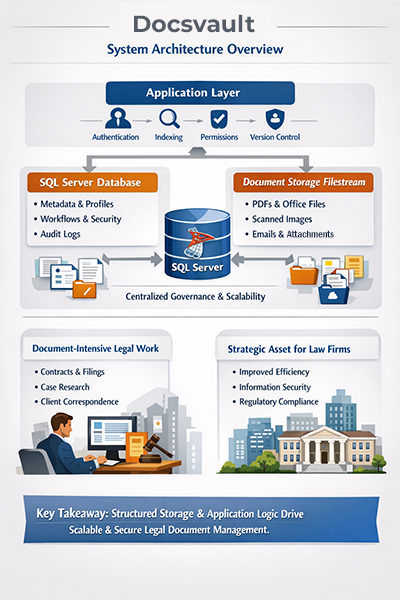
Docsvault is built on Microsoft SQL Server architecture to provide structured storage, indexing, and security enforcement.
Storage Design
- Metadata, profiles, workflows, user settings, and security policies are stored within the SQL Server database.
- Digital documents including PDFs, Office files, scanned images, drawings, and emails are stored using SQL Server Filestream technology.
- Filestream allows large binary objects to reside on disk while remaining logically integrated with the database for transactional consistency.
- The application layer manages authentication, indexing, permission enforcement, and version control.
This design provides centralized governance while enabling scalability for high document volumes.
Key Takeaway: Architectures that separate structured metadata, binary storage, and application logic enable scalability, transactional consistency, and centralized governance for high-volume legal repositories.
Matter-Centric Governance Architecture
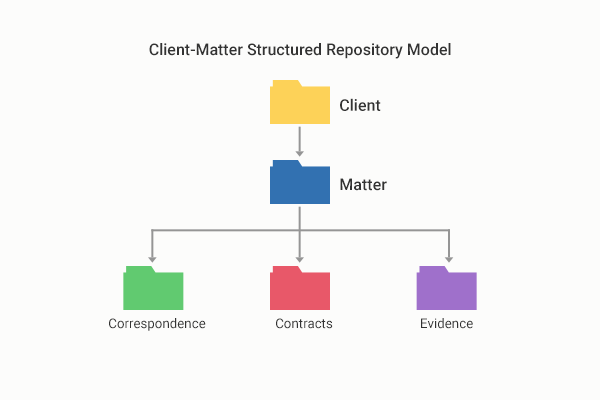
Legal work revolves around matters, not folders. Purpose-built document management systems organize information around cases, clients, or transactions rather than generic directory paths.
Docsvault enforces a client to matter hierarchy that aligns with actual legal workflows.
Structural Enforcement
- Every document is stored within a defined client and matter structure.
- Matter-level security inheritance ensures consistent permission propagation.
- User-level permissions override group-level permissions when required to enforce confidentiality constraints.
- Litigation hold capability prevents documents from being archived or deleted when preservation is required.
This structured hierarchy eliminates inconsistent filing practices and supports defensible audit readiness.
Key Takeaway: Governance structures aligned to legal workflows strengthen defensibility, enforce consistency, and eliminate reliance on individual filing habits.
Integrated Email
Modern legal operations require platforms that incorporate information directly from users’ working environments.
Docsvault integrates directly with Microsoft Outlook Desktop.
- Users can drag and drop emails into the correct matter workspace.
- Attachments are captured and indexed automatically.
- Email metadata including sender, recipient, subject, and timestamp is preserved.
- Document relations allow email threads to be grouped logically.
Key Takeaway: Structured email capture ensures matter completeness and audit integrity. Direct integration with Outlook reduces reliance on manual filing and prevents critical communication gaps.

Microsoft Office Integration
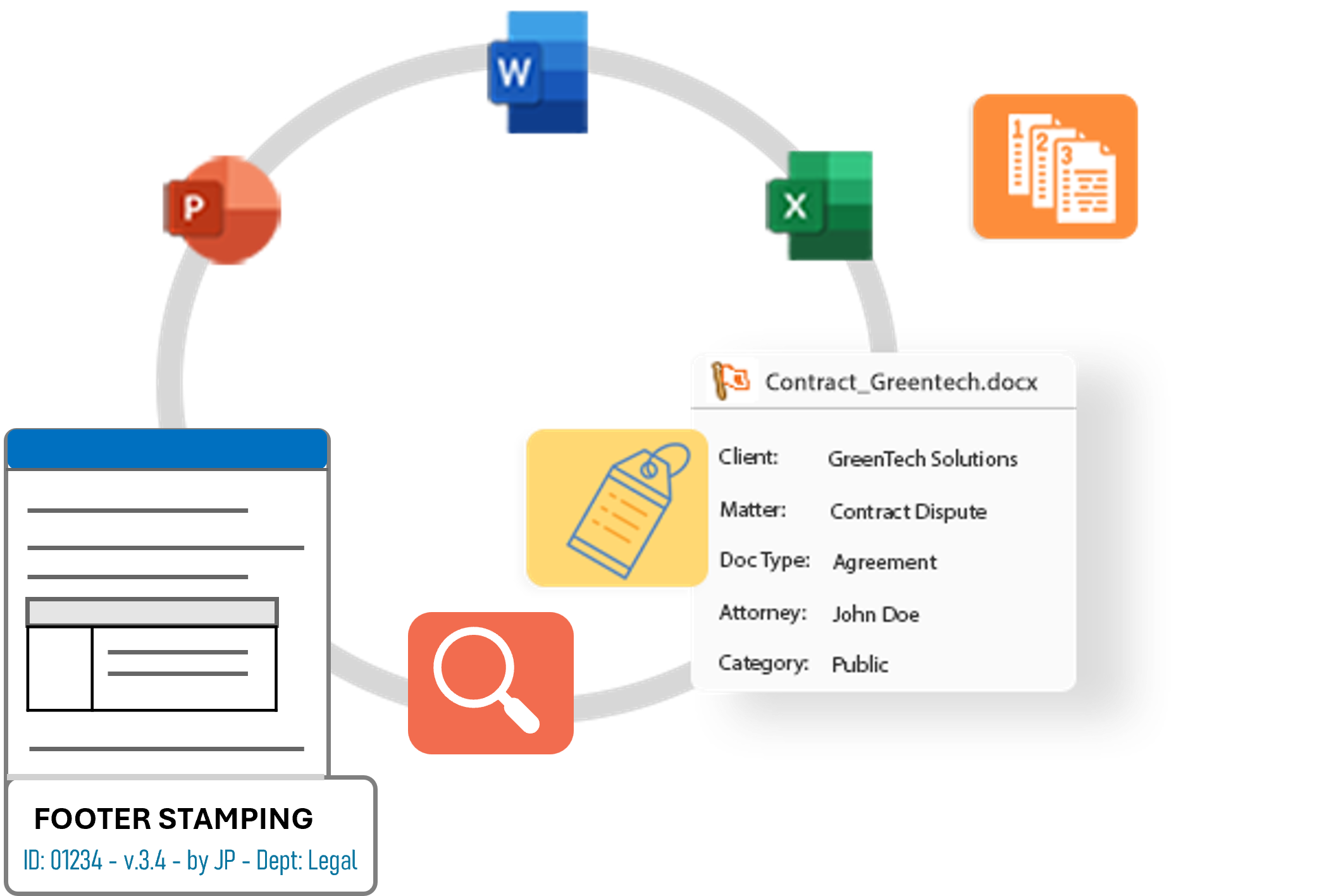
Integration with Word, Excel, and PowerPoint ensures governance within drafting workflows.
- Documents can be opened and saved directly into matter workspaces.
- Version enforcement prevents accidental overwriting.
- Document stamping with document id ensures traceable identification.
- Revision history is preserved within centralized control.
This integration reduces filing errors and strengthens consistency.
Key Takeaway: Governance embedded inside authoring tools improves adoption, reduces filing errors, and ensures document control occurs automatically during daily work.
PDF Governance and Litigation Readiness
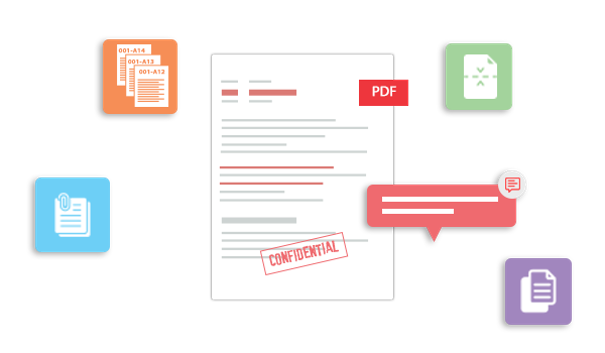
PDF remains the standard format for legal documentation due to its consistent presentation and widespread acceptance across courts and institutions. However, relying on external tools for PDF tasks introduces workflow inefficiencies and security concerns. Integrated PDF tools eliminate reliance on external utilities.
Capabilities include:
- Annotation tools for collaborative review.
- Redaction tools to permanently remove sensitive content.
- Digital signature workflows for execution management.
- Exhibit bundling for organized production.
- Bookmarking and indexing for structured navigation.
- Bates numbering to sequentially label documents during discovery production.
Maintaining these operations inside the repository ensures audit traceability.
Key Takeaway: Keeping PDF processing within a controlled repository environment ensures traceability, reduces risk exposure, and strengthens evidentiary reliability.
Advanced Indexing Architecture and Search Intelligence
Legal matters often involve thousands or even hundreds of thousands of documents. Modern platforms solve this complexity through indexing, tagging, and automated classification.
Docsvault utilizes SQL Server full-text indexing combined with application-layer enhancements.
Optical character recognition (OCR) transforms scanned documents into searchable text, enabling lawyers to locate specific names, clauses, or references within seconds – a dramatic upgrade from manual review.
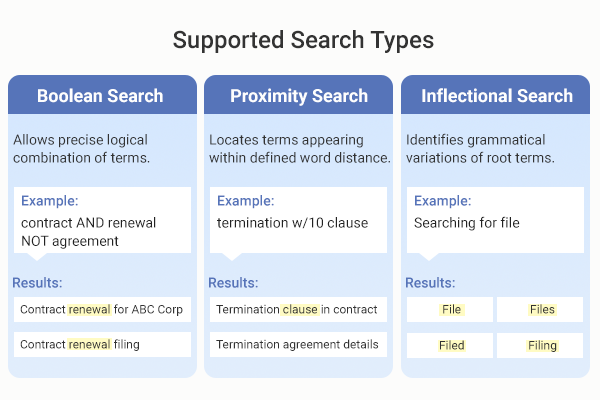
Supported Search Types
Boolean Search
Allows precise logical combination of terms.
Example: contract AND renewal NOT agreement
This retrieves documents containing both contract and renewal while excluding those referencing agreement.
Proximity Search
Locates terms appearing within defined word distances.
Example: termination w/10 clause
This returns documents where termination appears within ten words of clause.
Inflectional Search
Identifies grammatical variations of root terms.
Example: Searching for file retrieves file, files, filing, and filed.
Organizations using advanced document systems typically experience measurable reductions in retrieval time, enabling faster preparation for hearings, negotiations, and filings.
These capabilities also change how legal teams operate. Knowledge becomes institutional rather than individual, processes become repeatable, and collaboration becomes predictable. Legal performance depends equally on disciplined professional execution and the reliability of the systems that support it. New team members onboard faster, cross-team coordination improves, and firms reduce dependence on personal memory or manual filing habits.
Key Takeaway: Indexing architecture determines discovery speed, system scalability, and legal responsiveness. Sophisticated search frameworks transform repositories into operational intelligence systems.
Version Control and Audit Logging
Version control provides structured visibility into document evolution.
- Each edit generates a new version with timestamp and author attribution.
- Prior versions can be restored if required.
- Version comparison enables review of textual differences.
- Version history is maintained centrally to prevent uncontrolled duplication.
Audit logging captures:
- User logins and authentication events.
- Document access and download actions.
- Edits, deletions, and administrative changes.
- Exportable activity logs for compliance reporting.
Logs provide defensible traceability during disputes or audits.
This structured visibility reduces risk during high-stakes submissions by ensuring that only verified and current versions are used in official filings or client deliverables.
Key Takeaway: Version transparency and audit traceability are foundational requirements for legal defensibility, regulatory compliance, and dispute readiness.
Compliance and Security Controls
Security and compliance controls operate at multiple layers to ensure regulatory alignment, defensible auditability, and protection of sensitive legal information.
These controls collectively support regulatory obligations, client confidentiality requirements, and internal policy enforcement.
Access Control
- Role-based permissions at folder and document levels.
- User-level overrides when necessary.
- Ethical separation between matters through structured permission design.
These permission structures enforce ethical boundaries and demonstrate controlled information access during audits or investigations.
Encryption
- Encryption in transit for all communications.
- SQL Server Transparent Data Encryption available in Enterprise editions.
- Disk-level encryption such as BitLocker to protect stored data.
Encryption safeguards help organizations satisfy data protection standards and confidentiality mandates.
Backup and Recovery
- Manual backup capability for controlled snapshots.
- Scheduled automated backups for operational continuity.
- Restore validation procedures to ensure integrity.
Validated recovery mechanisms support continuity requirements and ensure records remain defensible if challenged.
Together, these layered protections establish a controlled infrastructure designed for regulatory review, client scrutiny, and operational reliability.
Key Takeaway: Multi-layered security architecture combining permissions, encryption, and recovery safeguards is essential for protecting legal data and maintaining regulatory readiness.
Discovery and Regulatory Readiness
Discovery requests, regulatory reviews, and investigations require organizations to produce complete records within strict deadlines. Delays, missing files, or incomplete document histories can result in procedural penalties, reputational harm, or adverse outcomes.
Structured document systems address this requirement by embedding readiness into daily workflows. Comprehensive audit trails record every document interaction including access, edits, transfers, and approvals. Searchable archives enable immediate retrieval using indexed content and defined filters. Retention controls ensure documents are preserved or disposed of according to policy requirements.
Key Takeaway: Discovery readiness is achieved through disciplined system design, not last-minute document assembly.
Secure Remote Access for Distributed Legal Teams
Legal professionals increasingly work across offices, courts, client sites, and remote locations. As a result, modern document systems must support secure access beyond traditional office networks while maintaining strict confidentiality controls.
Docsvault enables secure remote access while preserving strict permission controls.
- All data transmitted between user devices and the server is encrypted in transit.
- Integration with Active Directory enables centralized identity management and single sign-on authentication.
- Role-based access control is enforced at folder and document levels.
- Multi-factor authentication can be integrated to strengthen access verification.
- Comprehensive audit logs capture user access, edits, deletions, and administrative actions.
This architecture ensures that remote productivity does not compromise confidentiality or compliance.
Key Takeaway: Secure remote access is not a convenience feature; it is a compliance-critical capability that must enforce identity validation, permission control, and traceable activity.
Migration and Implementation Framework
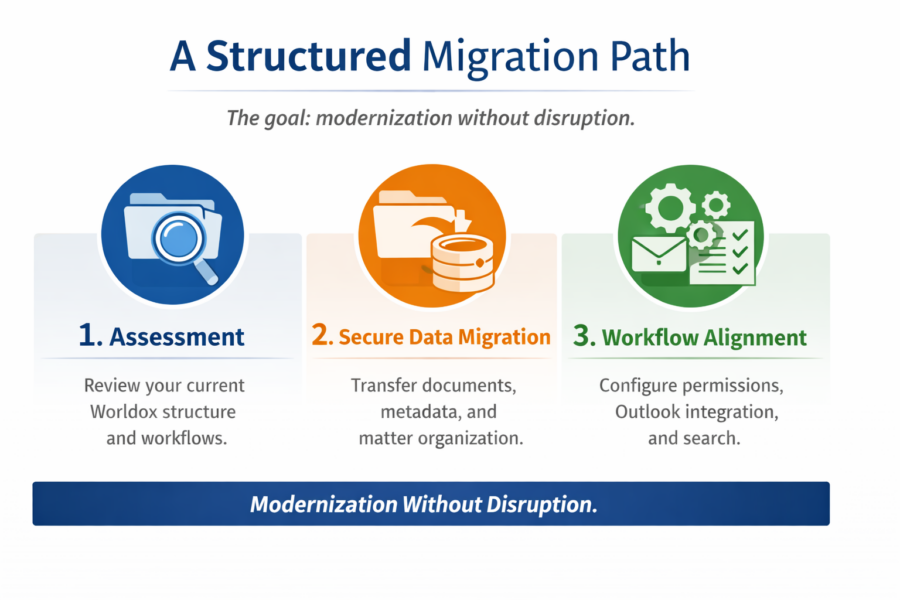
Migration is structured to minimize disruption.
- Repository analysis identifies existing folder structures and metadata.
- Metadata mapping aligns legacy fields with Docsvault schema.
- Migration from any legacy DMS preserves structure and metadata.
- Validation testing confirms integrity before production transition.
Deployment typically completes within one to two weeks, depending on repository size.
Key Takeaway: Structured migration methodology determines implementation success. Careful mapping, validation, and staged deployment minimize risk while preserving data integrity.
Artificial Intelligence Roadmap
Docsvault roadmap initiatives focus on enhancing search precision and classification efficiency.
Planned capabilities include:
- Hybrid rule-based and machine learning classification models.
- Predictive search suggestions based on usage patterns.
- Clause extraction for contract analytics.
- Document summarization for rapid review.
- FAQ generation from repository content.
AI processing executes within a controlled cloud environment while primary document storage remains under firm-managed infrastructure.
Key Takeaway: Artificial intelligence should enhance structured systems, not replace them. Controlled AI integration improves discovery speed, classification accuracy, and decision support without compromising governance.
Operational and Financial Impact
Structured document infrastructure produces measurable operational value beyond organization. Organizations implementing modern systems commonly experience:
- Faster document retrieval
- Reduced administrative workload
- Higher billable utilization
- Lower storage costs
- Fewer filing errors
- Reduced malpractice exposure
Over time these gains compound, improving turnaround speed, utilization rates, and overall profitability.
Key Takeaway: Document systems are performance infrastructure that directly influence efficiency, revenue, and risk reduction.
Conclusion
For leadership teams, document infrastructure is not merely an operational tool. It is a strategic asset that influences performance, risk exposure, client confidence, and competitive positioning. The systems used to manage legal information directly affect how efficiently teams operate, how securely data is protected, and how reliably organizations respond under pressure.
The platform is designed to function as long-term legal infrastructure rather than short-term software.
Docsvault provides:
- Matter-centric governance architecture
- Advanced full-text indexing and refined search capability
- Secure remote access controls
- Integrated capture across applications
- Compliance-grade audit logging
- Litigation-ready PDF tools
- Structured migration from any legacy DMS
For CIOs and legal leadership, selecting document infrastructure is a long-term architectural decision that directly influences security posture, operational agility, and compliance resilience.
Key Takeaway: Document infrastructure decisions determine a firm’s long-term resilience, compliance posture, and operational agility.
Supporting Evaluation Resources
Organizations reviewing legal document management platforms may find it helpful to explore detailed solution information and real-world implementation examples. The following resources offer additional context on capabilities and practical use: