Document Management for Law Firms: A Practical Guide

Every law firm depends on documents—contracts, pleadings, correspondence, discovery files, and records that carry legal, regulatory, and ethical obligations. When documents are difficult to find, poorly controlled, or inconsistently managed, the consequences go beyond inefficiency. They affect compliance, discovery readiness, and client confidence
This guide explains document management for law firms in practical terms: what it is, why it matters, the core capabilities legal teams need, and how modern document management systems help firms reduce risk and operate more effectively.
What Is Document Management in a Law Firm?
Document management in a law firm is the structured process of capturing, organizing, storing, retrieving, and governing legal documents throughout their lifecycle.
Unlike shared drives or basic file storage systems, legal document management systems are designed to support:
- Client- and matter-based organization
- Fast, reliable document retrieval
- Version control and audit trails
- Secure, role-based access
- Retention policies and compliance requirements
In legal practice, documents are not just computer files—they are work product, records, and evidence.
Why Document Management Is Critical for Law Firms?
- Poor document management exposes law firms to multiple risks
- Loss of client trust when information cannot be produced promptly
- Discovery delays due to missing or misfiled documents
- Compliance failures caused by inconsistent retention or access controls
- Malpractice exposure from outdated or incorrect document versions
Law firms are responsible for maintaining client documents in a way that supports confidentiality, accuracy, and timely access throughout a matter’s lifecycle. Professional law practice guidance, such as that promoted by the American Bar Association’s Law Practice Division , emphasizes the importance of organized records handling as part of responsible law firm operations. Structured document management systems help firms meet these expectations by improving document control, traceability, and retrieval while supporting broader compliance and governance needs.
External records management standards, such as ISO 15489 , further reinforce best practices for managing information from creation through retention and disposition.
Common Document Management Challenges in Law Firms
Many law firms struggle with:
- Documents scattered across shared drives, desktops, and inboxes
- Inconsistent naming conventions
- Difficulty retrieving older or archived files
- Multiple versions of the same document
- Manual filing dependent on individual user discipline
These challenges increase operational friction and legal risk as firms grow.
Core Features of Document Management Systems for Law Firms
A legal document management system should support the entire document lifecycle.
Client and Matter Management
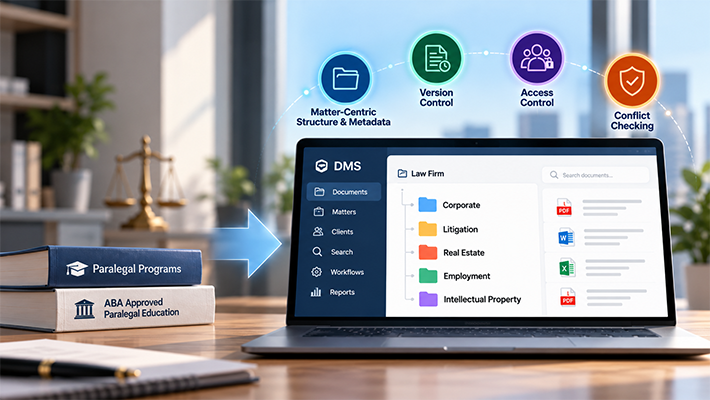
Legal documents must be organized by client and matter, not by generic folders. Matter-centric organization ensures that documents, emails, and records are consistently grouped and easier to manage for billing, discovery, and compliance.
📖 Client and matter management for law firms
Legal File Search and Retrieval
Legal teams need fast and accurate document retrieval. Legal document management systems use full-text search, metadata indexing, and OCR to locate documents across large repositories.
📖 Legal file search and retrieval
Email Management for Law Firms
Emails often contain approvals, instructions, and attachments that qualify as legal records. Managing emails alongside documents ensures complete matter histories and supports discovery obligations.
📖 Email Management for Law Firms
Document Version Control and Comparison
Legal documents go through multiple revisions. Version control ensures every change is tracked, prior versions are preserved, and documents can be compared reliably.
📖 Legal Document Version Control & Comparison
📖 Compliance with Version Control
Document Capture, Indexing, and Filing
Documents enter law firms from many sources—scanned paper, email attachments, uploads, and desktop files. Automated capture and indexing reduce manual errors and ensure documents are filed correctly.
📖 Legal Document Capture & Filing Automation
Compliance, Retention, and Audit Trails
Law firms must comply with document retention rules and maintain audit trails. Legal document management systems support defensible retention and access tracking.
File Servers vs Legal Document Management Systems
Many law firms rely on shared drives, but these tools lack features critical to legal work.
| Capability | File Servers | Legal DMS |
|---|---|---|
| Matter-based organization | Limited | Yes |
| Full-text & metadata search | Limited | Yes |
| Version control | No | Yes |
| Audit trails | No | Yes |
| Retention policies | Manual | Automated |
| Discovery readiness | Weak | Strong |
For firms handling sensitive or regulated documents, file servers are often insufficient.
Who Should Use Legal Document Management Software?
Small firms and mid-sized firms: Gain structure and reduce reliance on personal filing habits
Growing firms: Benefit from standardized workflows – improve consistency and collaboration
Large firms & legal departments: Require advanced security, auditability and compliance controls
It is the volume and sensitivity of documents, not the size of the firm that drive the need for a legal document management system.
Evaluating Document Management Solutions for Law Firms
When evaluating legal document management solutions, firms should assess:
- Matter-centric organization
- Search accuracy
- Email handling
- Version control and auditability
- Deployment flexibility
For a structured evaluation framework covering deployment options, feature checklists, TCO comparison, and vendor overview, see our Legal DMS Buyer’s Guide →
For readers seeking a deeper technical perspective on how structured systems support these evaluation factors in real-world legal operations, a comprehensive legal document management whitepaper provides detailed architectural and operational insight.
Real-World Impact of Document Management in Legal Practice
Law firms using structured document management systems report:
- Faster document retrieval
- Improved discovery readiness
- Reduced version-related errors
- Stronger compliance posture
Evaluating alternatives to Worldox?
Explore how law firms are planning their next step beyond legacy document management systems. View Worldox alternatives for law firms →
Frequently Asked Questions
Legal document management is the process of securely storing, organizing, retrieving, and sharing legal documents in a way that supports compliance, improves workflow efficiency, and enables seamless collaboration among legal professionals.
Law firms handle large volumes of sensitive legal documents. A DMS helps streamline document organization, improves searchability, ensures security and compliance, and enables efficient collaboration within teams.
In the context of legal document management and effective document management for law firms, a legal DMS strengthens security and compliance by enforcing role-based access controls, applying retention policies, and maintaining detailed audit trails. This helps law firms comply with regulations such as GDPR, HIPAA, and SOC 2 while reducing legal risk during audits and eDiscovery.
As part of modern legal document management and document management for law firms, a legal DMS centralizes and organizes documents and electronically stored information (ESI), making it easier to identify, collect, and review data during eDiscovery. Advanced search, secure access controls, and audit-ready records help law firms meet legal and regulatory requirements more efficiently.
Docsvault is designed for law firms that need secure, organized, and compliant document management. It offers meta-driven filing and retrieval, AI-powered data capture, document comparison for Word, and Excel, and tight Microsoft Office and Outlook integration — helping firms maintain control over confidential information while improving productivity.
When evaluating document management software, law firms should look for features such as:
- matter-centric document organization
- advanced document search and indexing capabilities
- email management
- version control and document history
- built-in PDF editing tools
- retention management and compliance controls
- security and role-based access control
- digital signatures
For a deeper explanation of these capabilities and how they support legal workflows, see Legal Document Management Software Explained.
Final Thoughts
Document management for law firms is more than file storage—it is about reducing risk, maintaining compliance, and enabling efficient legal work. A well-designed legal document management system provides the structure and control firms need to manage sensitive information confidently.
As hybrid work becomes the norm, firms must also evaluate how secure access is implemented. On-premise systems can support encrypted remote connectivity without moving sensitive data to the cloud—making it important to understand how secure remote access works within an on-premise legal DMS environment.