How Growing Law Firms Can Scale Without Losing Control of Their Documents

A growing law firm should be able to add attorneys, clients, and matters without making document management progressively harder.
But growth often exposes weaknesses that were easy to overlook when the firm was smaller. A folder structure that once seemed manageable can become inconsistent. More employees create more filing habits. More matters produce more documents and email. Finding the latest version can take longer. Information that was once easy to locate because “someone knew where it was” becomes harder to find when that person is unavailable.
The problem is not simply that the firm has more documents.
Growth changes the way document management needs to work.
As more people, matters, documents, and processes enter the organization, firms need a document-management approach that creates consistency, shared visibility, and control rather than increasing dependence on individual habits.
Why Document Management Gets Harder as a Law Firm Grows
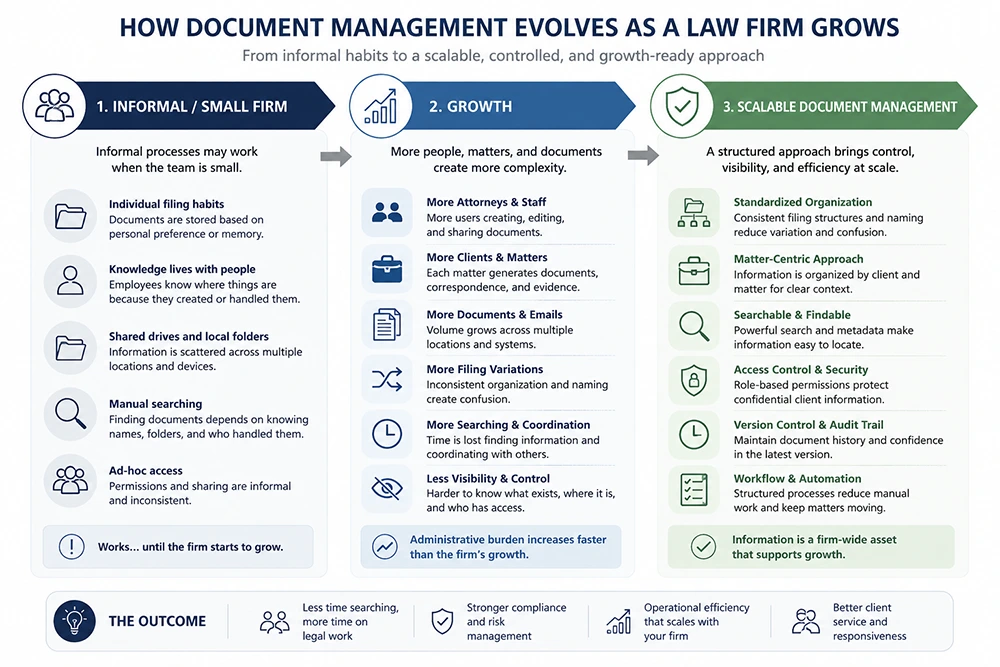
When a firm is small, informal document-management practices can appear to work. People know where information is stored, who handles a matter, and how the firm usually files documents.
Growth changes that.
More attorneys and staff mean more people creating, editing, filing, retrieving, and sharing information. More clients and active matters create more documents and correspondence. As collaboration increases, so does the number of decisions about where information belongs and who should have access to it.
The result can be a familiar pattern:
More people → more documents → more filing variations → more searching → more coordination → less visibility and control.
A document-management process that worked for a smaller firm may therefore become increasingly difficult to maintain as the firm expands.
The Hidden Cost of Relying on Individual Filing Habits
One of the earliest warning signs is that document knowledge lives with individuals rather than with the firm.
An employee knows which folder to check. An attorney remembers how a particular matter was organized. An administrator understands an informal naming convention that was never documented.
These practices can work until someone changes roles, goes on leave, or leaves the firm.
The underlying problem is not the employee. It is the dependency created by the process.
A growing firm needs information to remain understandable and accessible even when the people who originally organized it are unavailable. Instead of asking, “Who knows where this document is?” the firm should be able to ask, “Where would this document normally be organized, and how can an authorized user find it?”
What Changes When Documents Become Shared Business Information
Scalable document management means creating a consistent way to organize and access business information rather than relying on individual habits.
For a law firm, that can mean organizing information around clients and matters, establishing consistent filing practices, making information searchable, and applying appropriate access controls. A structured approach to document management for law firms can help turn these practices into a consistent firm-wide process.
The goal is not to create more rules for their own sake. It is to make routine document-management decisions more predictable.
A shared structure also makes the firm’s information less dependent on individual memory. When employees can understand where information belongs and how to retrieve it, the organization becomes easier to operate as people and matters increase.
6 Signs Your Firm’s Document Processes Are Not Scaling
Growth does not automatically mean that a firm needs to replace its existing document-management approach. But these patterns can indicate that the current process is becoming difficult to scale.
1. Employees regularly ask others where documents are
If finding information depends on knowing who created or handled it, the firm’s structure may be too dependent on individual knowledge.
2. Similar matters are organized differently
Inconsistent organization makes employees spend time learning how information was filed instead of working with it.
3. Finding the latest version takes effort
As collaboration increases, users need confidence that they are working with the appropriate document version.
4. Important emails remain disconnected from matter documents
When correspondence and documents are managed separately, users may need to search multiple places to understand the matter record.
5. New employees need extensive informal training
If onboarding depends heavily on experienced employees explaining where information is stored, the process may not be sufficiently standardized.
6. Administrative effort increases faster than the firm’s growth
If more attorneys, matters, and documents create disproportionate filing, searching, and coordination work, document processes may be limiting growth.
How to Build a Document Management Model That Scales
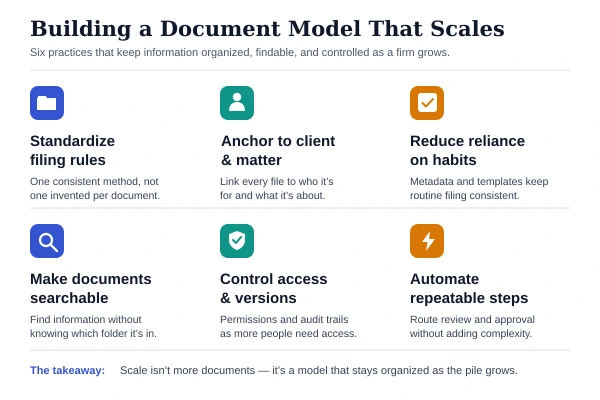
The objective is not simply to store more documents. A scalable model should make information easier to organize, find, control, and use as the firm grows.
Standardize how documents are organized
Define consistent approaches for filing and organizing information across the firm. The objective is to reduce unnecessary variation so employees do not have to invent a filing method every time they create or receive a document.
Organize information around clients and matters
For law firms, client and matter context provides an important organizing principle. Connecting information to the client and matter it belongs to can make related documents easier to understand and retrieve. A matter-centric document management approach can also help firms maintain this context as the number of clients, matters, and documents grows.
Reduce dependence on individual filing habits
Structured metadata, document profiles, templates, and standardized practices can help make routine filing decisions more consistent.
Make documents searchable and retrievable
As information volume grows, search becomes increasingly important. Users should be able to retrieve information without depending entirely on knowing which folder contains it.
Establish access and document-control rules
Growth increases the number of people who need access to information, but not everyone needs access to everything. A structured approach to permissions, version control, and auditability helps firms manage information consistently. For law firms, access controls also need to be considered alongside the obligation to protect confidential client information. ABA Formal Opinion 477R provides guidance on lawyers’ responsibilities when using technology to transmit and protect client information.
Automate repetitive document processes where appropriate
Some document activities are repetitive and predictable. Workflow automation can help structure appropriate review, approval, notification, and other repeatable processes without making the underlying process harder to understand.
When a Law Firm Has Outgrown Shared Drives and Informal Filing
Shared drives and informal filing practices are not automatically inadequate for every firm. The more useful question is whether the current approach continues to support the firm’s operational requirements as it grows.
Consider whether the existing environment provides:
- Consistent organization across matters and teams
- Reliable document search and retrieval
- Version control
- Appropriate access permissions
- Auditability
- Clear matter context
- Repeatable document workflows
- A structure that new employees can understand
If employees increasingly work around the system rather than through it, the firm may have outgrown its existing approach.
The transition does not have to be driven by document volume alone. It can be driven by the firm’s need for greater consistency, visibility, security, and control.
If your firm is evaluating whether it is time to move beyond shared drives or informal filing, this legal document management system buyer’s guide can help you assess the capabilities and considerations that matter when evaluating a solution.
How a Legal Document Management System Supports Growth
A legal document management system can provide the structure needed to support a growing firm’s information-management practices.
The important question is not how many features a system contains. It is whether its capabilities address the operational problems created by growth.
For example, matter-centric organization can help maintain client and matter context as the number of matters increases. Metadata-driven organization can provide a structured way to classify and retrieve information. Search can help users locate documents without depending entirely on folder knowledge.
Version control can help teams maintain document history. Security and permissions can help control access to confidential information as the number of users grows. Document and email management can help bring related information together rather than leaving important correspondence separated from matter documents. Workflow automation can help structure repeatable review and approval processes when manual coordination becomes burdensome.
The value comes from how these capabilities work together to create a more consistent document-management environment—not from any single feature.
A Practical Framework for Scaling Without Losing Document Control
A growing law firm can use a simple framework to evaluate its document-management processes:
Standardize → Organize → Search → Control → Automate → Review
- Standardize: Create consistent rules for how information should be organized and filed.
- Organize: Structure information around the business context that matters, including clients and matters.
- Search: Make information easier to retrieve without requiring users to remember exactly where it was stored.
- Control: Establish appropriate permissions, version control, auditability, and governance.
- Automate: Use workflow and other automation where repetitive processes can be made more consistent and efficient.
- Review: As the firm grows, periodically evaluate whether document-management practices continue to support its people, matters, information volume, and operational requirements.
A process that worked when a firm had 10 users may not be the right process when it has 50.
Growth Should Increase Capacity, Not Document Chaos
A law firm’s growth should create more capacity to serve clients—not more dependence on individual document-management habits.
As attorneys, staff, clients, matters, documents, and email increase, informal practices can become increasingly difficult to maintain. The answer is not simply to create more folders or ask employees to work harder.
The more sustainable approach is to create a document-management model built around consistent organization, shared information, reliable retrieval, appropriate control, and repeatable processes.
For firms evaluating whether their current approach can support the next stage of growth, a legal document management system can provide a structured foundation for managing documents and email as business information rather than as disconnected files.
If your firm’s document processes are becoming harder to manage as you grow, see how Docsvault’s Legal Document Management Software can help create a more structured, searchable, and controlled document environment.
Frequently Asked Questions
Growth introduces more users, clients, matters, documents, email, and collaboration. Without consistent processes, those increases can create more filing variation, searching, version confusion, and dependence on individual knowledge.
Common signs include employees asking where documents are stored, inconsistent organization between matters, difficulty finding the latest version, disconnected email and matter documents, and increasing administrative effort as the firm grows.
A firm can improve control by standardizing document organization, organizing information around clients and matters, making information searchable, establishing access and document-control rules, and automating appropriate repetitive processes.
A firm should evaluate its approach when existing processes make it difficult to maintain consistent organization, reliable retrieval, appropriate access, version control, matter context, or repeatable workflows as the organization grows.
Matter-centric organization connects documents and related information to the client and matter they belong to, providing a consistent structure that can make information easier for authorized users to understand and retrieve.
The appropriate approach depends on the firm’s current environment and requirements. The objective should be to establish a structured model that supports the firm’s operational processes without adding unnecessary complexity.