What Is a Digital Filing System? Benefits and Best Practices

Believe it or not, businesses are the largest consumer of paper, which is taking a heavy toll on the environment, forests, and other natural resources.
According to a report, a typical employee uses more than 10,000 sheets of copy paper each year. It has also been proved that over 50% of a business’s waste is composed of paper.
One of the best ways a business can become environment-friendly is by switching to a digital or electronic filing system.
Read on to learn what it is and how it can benefit your organization.
Understanding Digital Filing System
A digital filing system is a structured way to create, store, organize, classify, and retrieve digital files and documents. It provides an organized alternative to traditional paper filing, making information easier to find and manage.
A digital filing system can be as simple as a well-organized collection of folders and files on a computer or shared storage location. It can also be part of document management software that provides additional capabilities for organizing, searching, securing, and managing documents.
The terms digital filing system and electronic filing system are often used to describe similar approaches to organizing electronic documents. An electronic file management system may provide a broader set of capabilities for managing those files throughout their use and lifecycle.
The electronic file management system allows you to convert paper documents into digital ones, and that’s why it is sometimes called a paperless filing system.
However, converting paper documents into digital files is only one part of digital filing. The files also need to be organized in a consistent structure so users can find the information they need later.
For example, a company can store contracts, invoices, project documents, employee records, and correspondence in a structured digital filing system, organized by department, project, document type, or other relevant information. This makes documents easier for authorized employees to locate, access, and manage when needed.
A digital document filing system utilizes hard drive space or cloud storage to store and organize various types of business files for easy access.
The filing system may use local storage, shared storage, cloud storage, or document management software, depending on the organization’s requirements.
For organizations managing large volumes of documents, a centralized filing environment can make documents easier to access, organize, protect, and manage consistently rather than leaving important business information on individual computers or in disconnected locations.
A good digital filing system is not simply a collection of folders. It should provide a logical structure, consistent naming and classification practices, and an efficient way to retrieve information.
The effectiveness of a digital filing system depends largely on how well it is organized and how easily users can find the information they need.
Advantages of Using a Digital Filing System
There are many benefits to utilizing a tool that helps your business manage documents more efficiently and knowing them is the first step to picking the right digital document management system.
The most significant advantages of implementing a digital filing system include:
Less Physical Storage
Physical document storage consumes valuable office space that could otherwise be used for employees, collaboration areas, or business growth. Filing cabinets, storage boxes, and records rooms all contribute to overhead costs, especially as organizations accumulate more documents over time.
Industry estimates suggest that a standard four-drawer filing cabinet can require approximately 17 square feet of office space when access and clearance requirements are considered. By digitizing documents and implementing a digital filing system, organizations can reduce their dependence on physical storage while making information easier to access and manage.
Air-tight Security
A study finds that over 64% of companies have 1,000+ sensitive files accessible to every employee.
It’s a big problem as security issues can cause costly data breaches and other cyber threats to an organization.
An electronic filing system enables you to restrict access to sensitive documents as necessary. It also allows you to monitor who viewed or modified the document and when.
Improved Regulatory Compliance
Meeting regulatory and recordkeeping requirements can be challenging when documents are stored in paper files, shared drives, email inboxes, and other disconnected systems.
A digital filing system helps organizations maintain consistent document management practices by centralizing records, enforcing retention policies, and providing controlled access to sensitive information. Features such as a complete audit trail, version history, automated workflows, and document security controls make it easier to demonstrate compliance during audits and regulatory reviews.
By reducing manual processes and improving record visibility, organizations can better meet industry, legal, and internal compliance requirements while lowering the risk of missing, altered, or improperly stored documents.
Easier File Retrieval
A typical employee spends an estimated 30% to 40% of their time seeking or retrieving information kept in filing cabinets.
An electronic file management system simplifies the retrieval of documents with indexing, metadata, and tags. A simple keyword search gives you the required document in an instant.
Improved Workflow
The recent Nintex study reveals that 49% of employees face difficulty locating documents, 43% struggle to share documents, 33% have issues with document versioning and 43% find delay in document approval requests. That’s a lot of inefficiencies.
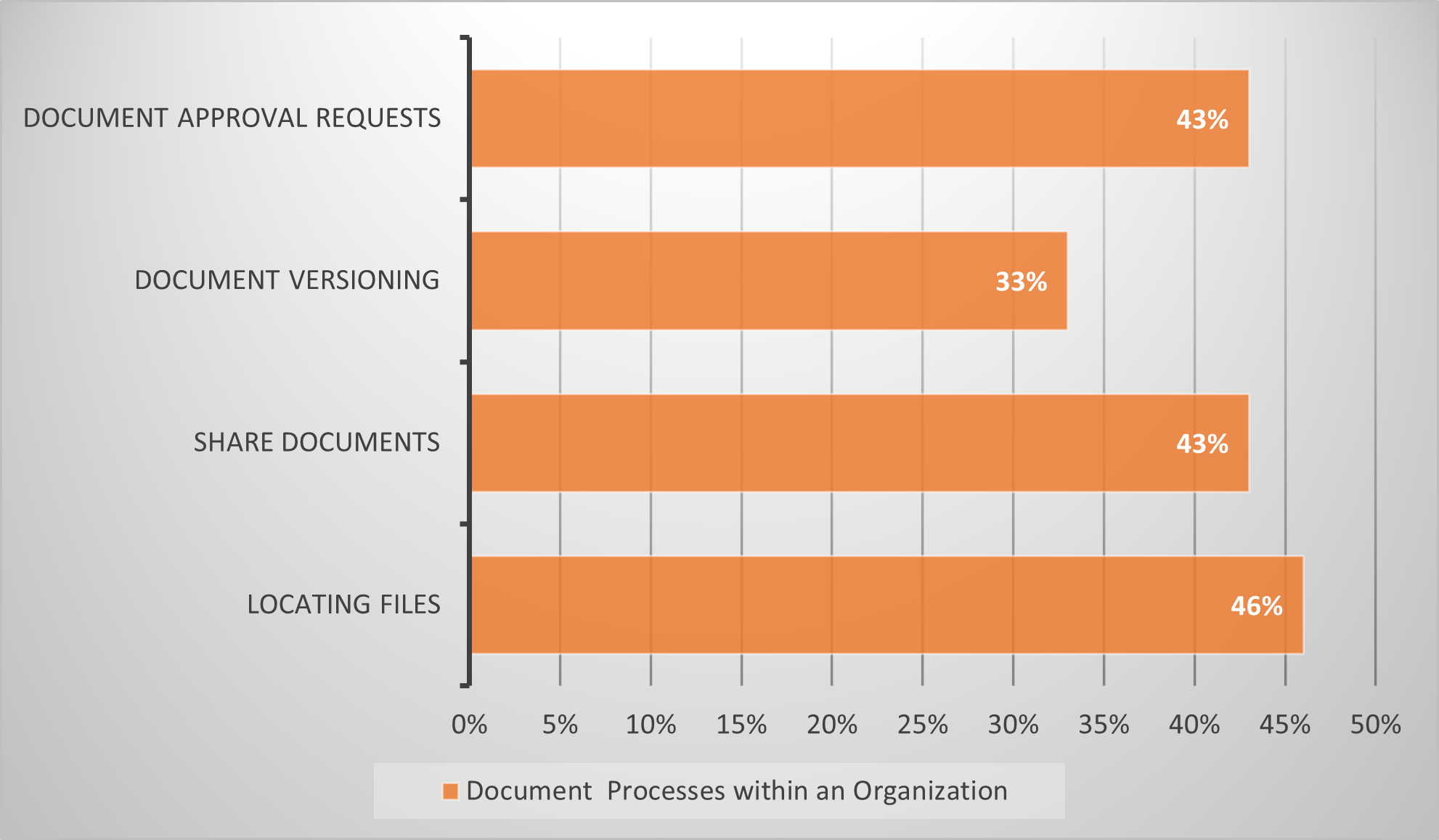
A digital document management system streamlines the entire workflow by housing files in an easy-to-use, centralized repository.
Not only can you find and share documents effortlessly, but you can also determine how recent the document is at a glance.
Better Collaboration
A detailed HBR study of 95 teams within 25 top corporations found that 75% of cross-functional teams are dysfunctional. The lack of collaboration may be to blame.
With digital document filing system, employees from different departments can collaborate on various documents with minimal effort – both internally within the organization as well as externally with stakeholders.
Better Backup & Disaster Recovery
Storing files and documents in physical format is both pricey and risky. You may lose years’ worth of valuable information anytime due to natural disasters like a fire, flood, or earthquake.
According to a report from FEMA, 40% of businesses do not reopen after a disaster. Reason? It becomes impossible to recover crucial files following a disaster.

With features like centralized storage, digital archiving, digitization, backups, etc., a digital filing system protects your documents from unprecedented incidents.
Increased Productivity
Productivity can be compromised when files are shared via email or paper copies. And if the document requires editing from multiple persons, it can drastically decrease productivity.
An electronic filing system saves your team valuable time with faster and more efficient document retrieval. Teams can do editing in real-time, which leads to higher productivity.
Better Version Control
Remember, per the Nintex survey, 33% of employees struggle with version control. Undoubtedly, this can create a lot of confusion and disorganization.
Where different document versions need to be maintained, a paperless filing system is a blessing.
It saves every version of a document and allows you to access a particular version whenever you want, saving you a lot of time and effort.
Cost Reduction
When used as the primary form for dispersing information, papers prove costly for a business.
As the cost of paper continues to skyrocket, the operational costs of running a business also steadily increase.
One of the most effective ways to keep these costs low is to stop relying on paper.
By eliminating the need for paper, an electronic file management system cuts overhead costs by 30% to 40%, which helps drive profitability and growth.
Easier Integration with Other Systems
Companies use roughly 137 unique apps or tools to get their work done.
A good digital document management system seamlessly integrates with many other systems, ensuring the smooth functioning of a business.
You won’t even have to worry about the synchronization and validation of data. The DMS software takes care of it all.
Competitive Advantage Over Other Businesses
An IBM and Oxford study found that 90% of startups fail within the first five years of inception.
To compete globally in the current era, money, quality, productivity, and consistency are the metrics by which a business can ensure its success.
A digital document filing system empowers you to compete with the best in today’s highly competitive corporate world.
How to Organize Digital Files: From Folders to Document Management
A digital filing system should make it easy for employees to know where documents belong and how to find them later. For organizations with a relatively small number of files, a well-planned folder and naming structure may be enough. As document volumes, users, and information requirements grow, however, relying only on folders can become difficult to manage.
Start With a Logical Folder Structure
Organize folders around meaningful business categories that reflect how your organization works and how employees are likely to look for information. Keep related documents together and use clear, consistent folder names.
For example, a company might organize project documents by department, project, client, or document type, depending on how employees typically access the information.
Avoid creating unnecessarily deep folder structures. If users have to navigate through many levels to reach a document, filing and retrieval can become cumbersome. A simpler structure can make documents easier to locate and maintain.
Establish Consistent Filing Rules
A digital filing system should not depend on how individual employees prefer to organize files. Establish consistent conventions for folder names, file names, document categories, and where different types of information should be stored.
These rules should also define how new folders or categories are created. Without a consistent approach, different users may create their own structures, resulting in duplicate folders, misplaced documents, and inconsistent filing practices.
Use Consistent File Naming Conventions
A consistent naming convention makes files easier to identify before opening them and can improve sorting and retrieval. File names should contain information that helps users distinguish one document from another without becoming unnecessarily long or complicated.
For example, instead of:
Final Contract.docx
use a more descriptive name such as:
ABC_Corporation_Service_Agreement_2026-09-08.docx
For project documents, a consistent format could be:
ProjectName_DocumentType_Date_Version
For example:
PRJ1201_ProjectPlan_2026-09-08_v02.docx
The exact convention should reflect how your organization searches for and manages documents. The important point is to use the same structure consistently rather than allowing each employee to create their own naming style.
Where information such as client, project, document type, or status is better managed as structured metadata, organizations should avoid putting every possible detail into the filename.
Keep Business Documents in a Central Location
Important business documents should not depend on individual computers or personal storage locations. Keeping documents in a centralized location makes them easier for authorized employees to access, share, protect, and manage.
Centralization also provides greater consistency when employees work from different locations or departments and need access to the same business information.
Use Metadata Alongside Folders
Folders provide an important organizational structure, but they cannot always capture all the information users need to identify a document.
Metadata and indexing can provide additional information such as client, project, document type, date, status, or department. This gives users more ways to identify and retrieve documents without relying entirely on the folder in which a file happens to be stored.
For a deeper explanation, see our guide to document indexing.
When Should You Consider a Document Management System?
A folder-based filing system can work well for simple requirements. However, organizations managing large volumes of documents, multiple users, sensitive information, or frequently changing files may need more than folders and filenames can provide.
A document management system (DMS) provides a structured environment for storing, organizing, searching, securing, and managing documents. Depending on the system, it can combine folders with metadata, indexing, permissions, version control, audit history, and other document-management capabilities.
The important distinction is that digital filing is about creating an organized way to store and retrieve information, while a DMS can provide the controls and management capabilities needed to operate that filing system at a larger organizational scale.
For organizations moving beyond basic folder-based filing, a DMS can therefore provide a more consistent way to manage documents while retaining the familiar concept of structured digital folders.
The Most Important Features to Look
for in a Digital Filing System
A digital filing system might have many different features, but it must have the ability to capture and retrieve information in the first place. Let’s look in detail at how these two core features should work:
-
Capture Information From Scanned Documents
The best paperless filing system is the one that allows you to scan digital documents directly.
It should be doubled as a document scanning software to streamline the entire process. Look for features like:
- Automatic document separation
- Built-in optical character recognition (OCR)
- Automatic routing
- Automatic file naming
-
Capture Information From Printed Documents
When picking the best digital filing system, ensure it allows you to “print” documents directly into the system.
This is usually done through a virtual printer that captures an image of the document and stores it as PDF in the filing system.
This is fine for archival, but you won’t be able to save documents in their native format. In other words, you won’t be able to edit the captured documents.
Hence, ensure the electronic file management system provides a way to capture, save, and edit Excel spreadsheets, Word documents, and other formats in their native format.
-
Save Function
The best paperless filing system will tie into other programs’ “Save” and “Save As” functions.
This makes it effortless to automatically save documents into the system without any plug-in or add-on.
So look for a digital document management system that tightly integrates with “Save” and “Save As” functions.
This will ensure that your software captures everything.
-
Document Retrieval
When choosing the best paperless filing system, make sure it stores your files in regular folders.
This will give you complete access and control over your files and folders.
Also, ensure the document management system releases the file from the database before you edit it, share it, or use regular software packages to work with it.
How Can Docsvault Help You?

Docsvault provides a centralized environment for storing, organizing, finding, and managing business documents. It combines familiar folder-based filing with capabilities that help organizations manage documents more consistently as their volume and number of users grow.
The key capabilities relevant to digital filing include:
Document Profiling and Tagging
Assign groups of custom index fields to files and folders to add structured information to documents and make them easier to find.
Use advanced search to locate documents using information such as document properties, indexes, and other available search criteria.
Capture paper documents digitally through scanning and batch scanning, helping organizations move information from physical filing into a digital repository.
Control access to documents and folders using user- and group-based permissions and system-level rights.
Retain document versions and access previous versions when needed, helping users work with the appropriate version of a document.
Group and access related documents that may be filed in different locations within the repository.
Create predefined folder structures to help maintain consistent filing practices when similar sets of documents need to be organized repeatedly.
Maintain a history of activities performed on files and folders within Docsvault, providing visibility into document activity.
Together, these capabilities allow organizations to move beyond simply storing files in folders and create a more structured approach to digital document filing and management.